


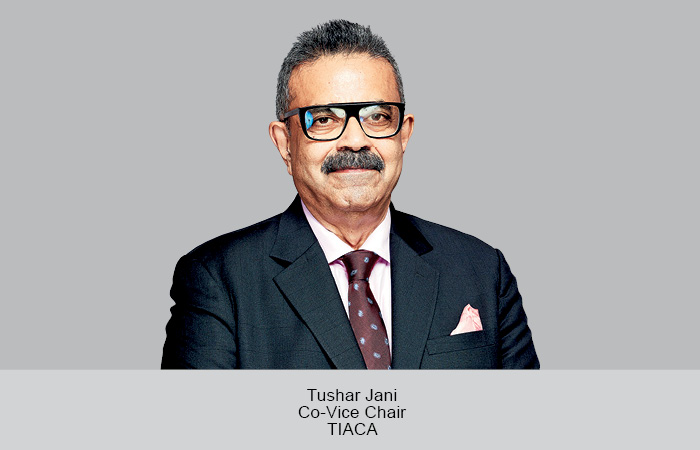
The appointment of Tushar Jani, Group Chairman, CSC Group, as Co-Vice Chair, TIACA, marks a global milestone for Indian logistics and reinforces his vision for positioning India as a future cargo powerhouse. He also brings to TIACA a roadmap mirroring India’s ambitions to emerge as a leading hub in global trade.
Ritika Arora Bhola
Tushar Jani, Group Chairman, Cargo Service Centre (CSC) Group of Companies has been elected as Co-Vice Chair, TIACA, marking a milestone for Indian logistics leadership on the global stage. The announcement was made during the Air Cargo Forum 2025, held recently in Abu Dhabi, UAE, where TIACA unveiled its new leadership team.
Jani joins Emir Pineda of the Miami-Dade Aviation Department as Co-Vice Chair, supporting newly appointed Chair Roos Bakker of ICTS Europe.
His appointment reflects his decades-long commitment to transforming India’s logistics and aviation sectors. With 50 years of leadership, he has been instrumental in shaping the industry through innovation, policy advocacy, and infrastructure development.
Jani helped establish India’s first private air cargo carrier and revolutionised express logistics in the country. His contributions have been pivotal in modernising the Indian air cargo ecosystem through PPPs and strategic policy frameworks.
“I am honoured to join TIACA’s leadership team at such a pivotal time for global air cargo,” said Jani, adding “This role is not a recognition of my journey, but a reflection of the country’s growing voice in shaping the future of global logistics. I look forward to working collaboratively with industry leaders across the world to drive innovation, sustainability, and inclusive growth.”
On being asked about his priorities as the Co-Vice Chair of TIACA, he said, “My focus centres on three interconnected pillars. First, accelerating technology adoption and digitisation across the cargo ecosystem. I am committed to embedding electronic air waybills and customs automation as standard practice across India’s networks. Second, leveraging infrastructure expansion. With 160 planned airports and aircraft orders exceeding 600 units from domestic carriers, I must ensure these assets are operationalised and integrated into seamless multimodal corridors. Third, building human capital and operational resilience in emerging regions, particularly the Northeast, where education and language skills are creating new trade potential supporting ‘China plus one’ strategy for global manufacturers.
I recognise that integrating multimodal infrastructure across regions, such as linking ports, airports, and inland transport is becoming critical. Take Navi Mumbai airport as an example, its potential lies in multimodal coordination, as JNPT port is 50 km away. Equally important is aligning regulatory frameworks with global standards, while supporting emerging hubs that will attract new investment as government-led infra projects accelerate. These priorities are not isolated initiatives, they are interlinked strategies that position the logistics sector to compete globally. The industry rewards efficiency and innovation, and our cultural mindset ensures Indian carriers, forwarders, and integrators will lead on the global stage.”
Talking about his long-term vision for India emerging as a global air cargo hub, Jani said, “India’s ascendancy as a global air cargo hub is inevitable, driven by three foundational realities: Manufacturing capacity, consumption base, and embedded entrepreneurial ethos. We are becoming the world’s largest production house and the biggest iPhone production takes place in India today. Pharma electronics and defence equipment production are scaling rapidly, with 40 per cent of generic drugs produced domestically and 60 per cent of USA pharma imports sourced from India.
This vision is underpinned by cost-effective transportation infra; trucking rates around US$ 8 per tonne globally enabling efficient intermodal transfers. I project air cargo growth of 4–5 per cent, complemented by sea cargo expansion of 7–8 per cent, creating a synergistic ecosystem. Govt infra development across India, especially the Northeast, will create corridors linking the country with Southeast Asia and beyond. India’s growth will speed up because our infrastructure is becoming growth-oriented and our regulatory environment is modernising. Our operators combine historical experience with cutting-edge innovation. This cultural mindset — ‘do or die’ mentality — ensures competitive success on the global stage. India’s emergence as a global air cargo hub will be defined by the confluence of policy reform, infrastructural investment, manufacturing scale, and entrepreneurial resilience.
Jani’s election truly underscores the country’s commitment to inclusive international representation and its mission to unite all sectors of the air cargo industry in pursuit of innovation, sustainability, and growth.